A home does not necessarily need more square footage to feel larger. Sometimes, it simply needs better organization. When everyday belongings are scattered across countertops, floors, shelves, and furniture, even a spacious room can start to feel cramped. The good news is that clever storage can change the entire atmosphere of a home without requiring a major renovation.
Hidden storage ideas are especially useful because they keep possessions accessible while reducing visual clutter. Instead of adding another bulky cabinet or filling every wall with shelves, you can look beneath beds, inside benches, behind doors, under stairs, and even within furniture you already own.
Hidden Storage Ideas at a Glance
| Storage Solution | Best Room | What to Store | Main Benefit |
|---|---|---|---|
| Under-bed drawers | Bedroom | Clothing, shoes, bedding | Uses unused floor space |
| Storage ottoman | Living room | Blankets, games, toys | Seating plus storage |
| Storage bench | Entryway | Shoes, bags, accessories | Creates organized entrance |
| Under-stair cabinets | Hallway | Shoes, tools, household items | Uses awkward space |
| Toe-kick drawers | Kitchen | Trays, linens, utensils | Uses forgotten cabinet space |
| Mirror cabinet | Bathroom | Toiletries, grooming items | Combines mirror and storage |
| Door organizers | Any room | Small accessories | Uses vertical space |
| Window seat | Bedroom/Living room | Books, blankets, toys | Seating plus concealed storage |
| Storage headboard | Bedroom | Books, chargers, accessories | Replaces bedside furniture |
| Floating cabinet | Bathroom/Living room | Everyday items | Keeps floor visually open |
| Hidden charging drawer | Office/Living room | Cables, chargers, devices | Eliminates cable clutter |
| Lift-top coffee table | Living room | Games, books, electronics | Storage plus workspace |
| Pull-out pantry | Kitchen | Food, spices, bottles | Makes narrow gaps useful |
| Built-in wardrobe | Bedroom | Clothing and accessories | Maximizes vertical space |
| Stair drawers | Hallway | Shoes, seasonal items | Converts dead space |
| TV wall cabinetry | Living room | Electronics, games, cables | Hides entertainment clutter |
The result is surprisingly powerful. When fewer objects are visible, rooms tend to feel calmer, cleaner, and more open. This guide explores practical hidden storage solutions for bedrooms, kitchens, bathrooms, living rooms, entryways, and small homes. Whether you live in an apartment or a large family house, these ideas can help you make better use of the space you already have.
Why Hidden Storage Can Make a Home Feel Bigger
Visual clutter has a major effect on how we perceive a room. A floor covered with baskets, shoes, toys, bags, and miscellaneous items can make the available space appear much smaller than it actually is.
Hidden storage solves part of this problem by moving belongings out of sight without removing their usefulness. Instead of seeing dozens of individual objects, your eyes see clean surfaces and uninterrupted lines.
This does not mean everything needs to disappear behind a door. The goal is balance. Decorative objects, books, plants, and artwork can remain visible, while less attractive or frequently scattered items can be tucked away.
Another advantage is that hidden storage encourages intentional organization. When every category of item has a designated place, cleaning becomes easier and rooms are less likely to become overwhelmed with clutter.
Quick Guide to Hidden Storage Solutions
| Storage Idea | Best Location | Ideal For | Space-Saving Benefit |
|---|---|---|---|
| Under-bed drawers | Bedroom | Clothing, bedding, shoes | Uses otherwise wasted floor space |
| Storage ottoman | Living room | Blankets, games, remotes | Combines seating and storage |
| Built-in bench | Entryway | Shoes, bags, accessories | Uses wall-edge space efficiently |
| Stair storage | Hallway | Household items | Turns dead space into useful storage |
| Toe-kick drawers | Kitchen | Trays, utensils, cleaning items | Uses overlooked lower cabinet space |
| Hidden wall cabinets | Any room | General belongings | Keeps surfaces visually clean |
| Behind-door organizers | Bedroom/Bathroom | Small items | Uses vertical space |
| Window-seat storage | Bedroom/Living room | Books, blankets, toys | Combines seating with storage |
| Floating cabinets | Bathroom/Kitchen | Essentials | Opens up floor space |
| Mirror cabinets | Bathroom | Toiletries | Provides storage without extra furniture |
| Headboard storage | Bedroom | Books, chargers, accessories | Uses wall space behind the bed |
| Under-stair drawers | Staircase | Shoes, tools, seasonal items | Converts awkward space into storage |
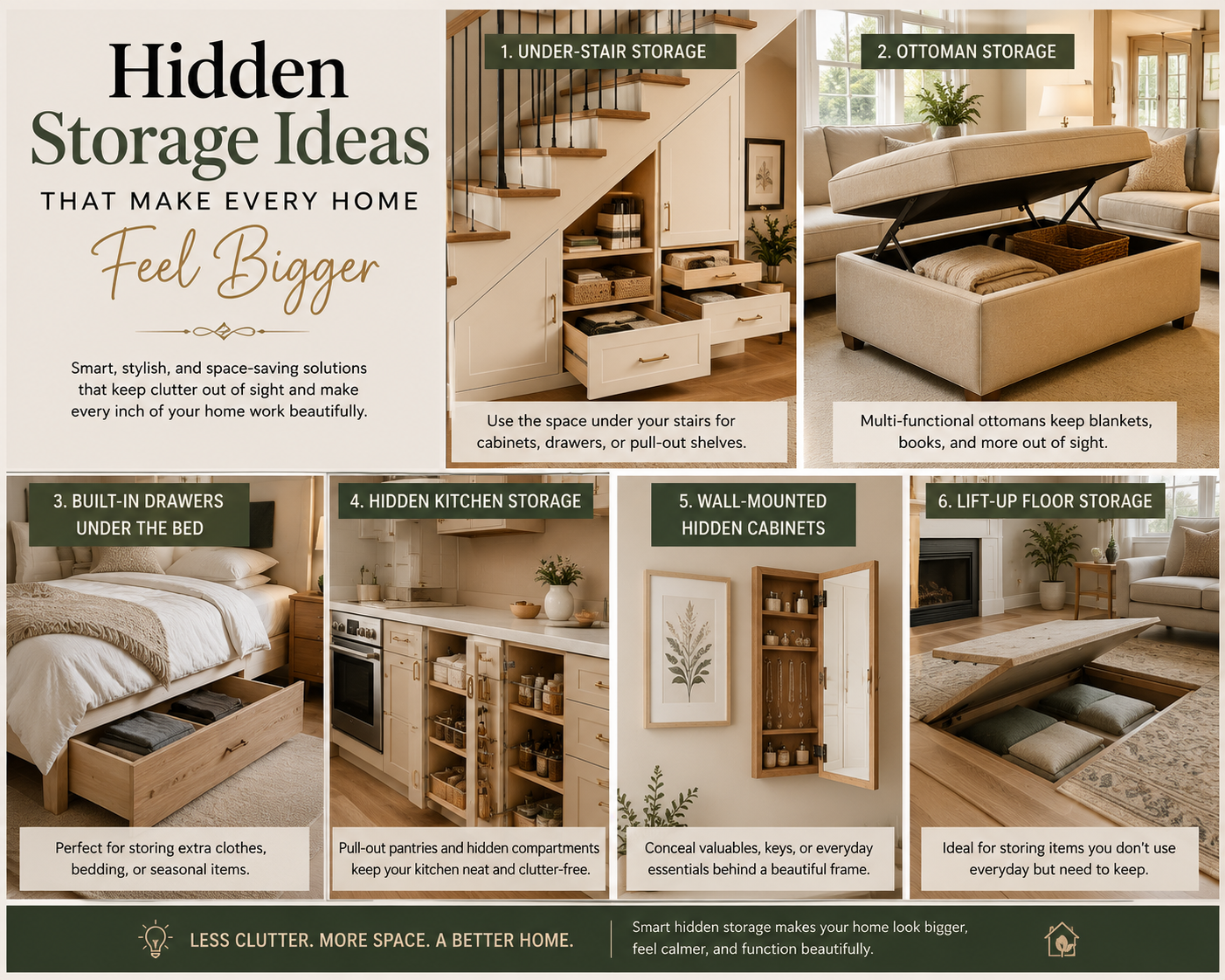
1. Turn the Space Under Your Bed Into a Storage Zone
The area beneath a bed is one of the easiest places to create hidden storage. Yet many people leave it completely unused or allow it to become a dusty collection point for random belongings.
Instead, use shallow rolling containers, built-in drawers, or purpose-made under-bed boxes. This area is particularly useful for things you do not need every day.
Winter clothing, spare bedding, luggage, shoes, blankets, and seasonal decorations can all live comfortably underneath the bed.
If your bedroom is small, this solution can eliminate the need for another large storage unit. Keep similar items together and label containers so you do not have to pull everything out whenever you need one particular thing.
For an especially clean appearance, choose containers that slide completely beneath the bed and remain invisible from normal standing height.
2. Choose an Ottoman That Does More Than Provide Seating
A storage ottoman is one of those furniture pieces that quietly solves multiple problems at once. It can act as a footrest, extra seating, a coffee-table alternative, and a storage container.
Use it in the living room for blankets, board games, children’s toys, magazines, or extra cushions. In a bedroom, a storage bench at the foot of the bed can provide a convenient place to sit while also hiding belongings.
The secret is choosing the right size. A large ottoman can be extremely useful, but it should not make movement around the room difficult.
Look for furniture with a hinged lid or removable top that gives you quick access to the interior. If the storage compartment is deep, use smaller baskets or dividers inside so it does not become a cluttered black hole.
3. Create a Hidden Storage Bench in the Entryway
The entryway is often the first area to become messy. Shoes, umbrellas, handbags, backpacks, jackets, and shopping bags tend to accumulate near the front door.
A built-in or freestanding storage bench can dramatically improve this situation. The top provides a comfortable place to sit while putting on shoes, while drawers or lift-up compartments hide everything underneath.
If you have children, assign each family member a specific compartment. This makes it easier to maintain order because everyone knows where their belongings belong.
You can also install hooks above the bench for coats and bags. Keeping the lower area closed while using the upper wall for carefully selected hooks creates a practical but visually tidy entrance.
4. Make the Most of the Space Under the Stairs
The triangular area beneath a staircase is often treated as unusable space. In reality, it can become one of the most valuable storage areas in the house.
Depending on the staircase design, you can install pull-out drawers, cabinets, shelving, or a combination of all three.
Small drawers near the lower end can store shoes and accessories. Larger compartments can hold cleaning supplies, luggage, sports equipment, or household tools.
For a polished look, use cabinet fronts that match the surrounding walls. When the doors blend into the architecture, the storage becomes much less noticeable.
This is particularly effective in smaller homes because it transforms an awkward architectural feature into functional storage without consuming additional floor area.
5. Install Toe-Kick Drawers in the Kitchen
Kitchen cabinets often have a small recessed section at floor level known as the toe kick. Most homeowners never think of it as storage.
However, shallow drawers can sometimes be installed in this overlooked area. They are ideal for flat or infrequently used items such as baking trays, cutting boards, serving platters, or kitchen linens.
Because these drawers are close to the floor, they are not suitable for everything. But for the right items, they can provide valuable additional capacity without changing the appearance of the kitchen.
This is a great example of hidden storage because the space was already there. You are simply using it more intelligently.
6. Use the Space Behind Doors
Doors are often forgotten when planning storage. Yet the back of a door can provide valuable vertical space.
Slim organizers can hold cleaning products, toiletries, accessories, craft supplies, shoes, or pantry items. In bedrooms, over-the-door organizers can keep scarves, belts, handbags, and other small accessories under control.
The key is to avoid making the organizer too deep. If it sticks out too far, the door may not open properly or the room may feel tighter.
Choose a narrow system that keeps objects close to the door surface. This preserves walking space while turning an overlooked area into useful storage.
7. Add a Hidden Cabinet Behind a Bathroom Mirror
Bathrooms have limited wall space, so every inch matters. A mirrored medicine cabinet can provide storage while performing the job of a traditional mirror.
Instead of placing toiletries on the sink or countertop, store them behind the mirror. Toothpaste, skincare products, shaving supplies, medications, and grooming accessories can all be organized inside.
For a minimalist bathroom, this solution is especially effective because it reduces countertop clutter.
If you are renovating, consider a recessed medicine cabinet that sits inside the wall. This creates a much cleaner appearance than a cabinet that projects outward.
8. Turn a Window Seat Into a Storage Compartment
A window seat can become much more than a comfortable place to read.
Build a hinged or lift-up seat with storage underneath. The compartment can hold blankets, children’s toys, books, seasonal decorations, or other items that you want nearby but not visible.
Window-seat storage also has a psychological advantage. Because the storage is incorporated into a seating feature, it does not visually register as another large cabinet.
Add a cushion and a few pillows, and you have created both a cozy reading area and a practical storage solution.
9. Use the Space Inside a Headboard
A headboard can become an excellent hidden storage feature. Instead of using a purely decorative headboard, consider a design with shelves, cabinets, or concealed compartments.
This is particularly useful in bedrooms without bedside tables. Small shelves can hold books, glasses, chargers, and other nighttime essentials.
A closed cabinet can hide less attractive objects such as cables and electronic accessories.
For a compact bedroom, a storage headboard can eliminate the need for additional furniture and preserve valuable walking space around the bed.
10. Build Cabinets Into Empty Wall Space
Large blank walls are not always a reason to add open shelving. If your primary goal is to reduce visual clutter, closed cabinetry can be a better choice.
Floor-to-ceiling cabinets provide substantial capacity while keeping belongings hidden. When cabinet doors are painted the same color as the wall, the furniture visually blends into the room.
This technique works particularly well in living rooms, home offices, hallways, and bedrooms.
Rather than placing several small storage pieces around a room, one carefully designed wall of cabinetry can create a much calmer appearance.
11. Install Floating Cabinets
Floating furniture is another smart way to create a feeling of openness.
Because the cabinet is mounted to the wall rather than sitting directly on the floor, the floor remains visible underneath. That uninterrupted flooring can make the room appear more spacious.
Floating cabinets work especially well in bathrooms and smaller living areas.
Use closed doors if you want to hide clutter. Keep the exterior simple and avoid overcrowding the top with decorative objects.
The combination of concealed storage and visible floor space creates a lighter visual effect.
12. Hide Storage Inside a Coffee Table
A coffee table does not have to be an open surface surrounded by clutter. Look for designs with drawers, lift-up tops, or hidden compartments.
This is an excellent place to store remote controls, magazines, chargers, notebooks, children’s games, and small electronics.
A lift-top coffee table can also provide a temporary workspace, making it useful in homes where a separate office is not available.
When choosing one, pay attention to the opening mechanism and interior dimensions. A beautiful table is only useful if you can access the storage comfortably.
13. Use the Space Above Kitchen Cabinets Carefully
The space above kitchen cabinets can either become a useful storage zone or a collection point for dust.
If the cabinets do not reach the ceiling, consider using attractive closed boxes or matching containers for items that are rarely needed.
Holiday serving pieces, specialty cookware, and infrequently used kitchen equipment can be stored there.
However, avoid filling this area with random objects simply because there is space available. The goal is organized hidden storage, not moving clutter from one location to another.
14. Create a Pull-Out Pantry
A narrow gap between cabinets can sometimes be transformed into a pull-out pantry.
Tall, slim drawers are particularly useful for spices, sauces, canned foods, bottles, and dry ingredients.
Because everything slides forward, you can see the entire collection instead of losing items at the back of a deep cabinet.
This type of storage is especially valuable in small kitchens where conventional pantry space is limited.
Use adjustable shelves or compartments to accommodate different container sizes.
15. Hide Cables and Electronics
Electronic cables can make even a beautifully organized room look messy.
Instead of leaving chargers and power strips exposed, create a concealed charging drawer or cable-management compartment.
A drawer beside a sofa or desk can contain charging cables, power banks, headphones, and small devices. Add a cable opening at the back so devices can charge without leaving wires scattered across the room.
This small change can have a surprisingly large effect on the appearance of a space.
16. Make Your Stairs Work Harder
If your staircase has closed risers, consider whether some of the space beneath individual steps can be converted into drawers or cabinets.
These compartments can be surprisingly useful for shoes, household supplies, books, toys, and seasonal items.
The design needs to be carefully planned so that the storage does not interfere with the staircase structure or safety.
When executed properly, stair storage can turn previously unused space into a highly functional part of the home.
17. Add Hidden Drawers to a Desk
A home office can quickly become overwhelmed by stationery, notebooks, cables, documents, and electronic accessories.
A desk with concealed drawers provides a simple solution. Keep the everyday workspace almost empty while storing necessary supplies within arm’s reach.
You can dedicate separate compartments to documents, writing supplies, technology accessories, and personal items.
This approach is especially helpful if your home office doubles as another room. When work is finished, you can close the drawers and make the space feel like a normal living area again.
18. Use Built-In Storage Around the Television
Television walls often become cluttered with gaming consoles, speakers, remotes, routers, DVDs, and cables.
Instead of placing every device on visible shelves, create cabinetry around the television.
Open sections can display a few decorative objects, while closed compartments hide electronics and accessories.
Cable management should be incorporated into the design. This prevents wires from becoming the most noticeable feature of the wall.
A balanced combination of open and closed storage can make the entire entertainment area look more intentional.
19. Create Storage Under a Raised Floor
In certain rooms, a raised platform can provide a hidden compartment underneath.
This technique can work particularly well in bedrooms, children’s rooms, and multi-purpose spaces.
The platform does not have to cover the entire room. Even a small raised section can create storage for seasonal items or bulky belongings.
This solution is more involved than simply adding baskets or drawers, so it should be considered during renovation or remodeling rather than as a quick weekend project.
20. Use Furniture With Secret Compartments
Modern furniture increasingly combines multiple functions.
Beds can include drawers. Sofas can hide compartments. Benches can open from the top. Mirrors can conceal cabinets. Desks can contain charging stations.
When purchasing new furniture, ask yourself one simple question:
Can this piece perform two jobs instead of one?
A storage bed can replace a traditional bed and several storage boxes. A storage bench can replace a chair and a cabinet. A lift-top table can function as both a coffee table and a workspace.
Choosing multifunctional furniture is one of the easiest ways to make a small home work harder.
How to Keep Hidden Storage Organized
Hidden storage is not automatically organized storage. A closed cabinet can still contain chaos.
Start by grouping similar items together. Instead of throwing everything into one large compartment, create categories.
For example, a bedroom storage drawer might contain:
- Winter accessories
- Spare bedding
- Handbags
- Travel items
Use smaller containers inside large drawers when necessary. Labels can also help, particularly when storing seasonal belongings that you may not access for several months.
Another important rule is to avoid storing things simply because you have empty space. Before placing an item into hidden storage, ask whether you actually use it.
The best storage system is one that makes your life easier, not one that gives clutter a better hiding place.
How to Make Hidden Storage Look Beautiful
Function matters, but appearance matters too.
If you are installing built-in storage, consider matching cabinet fronts to the wall color. This can make large storage units visually disappear.
Choose consistent handles and finishes rather than mixing too many styles.
For open storage, leave some breathing room between objects. Completely filling every shelf can make the room feel crowded even when the floor is clean.
A useful design principle is to combine hidden storage with a few carefully selected visible elements. This gives the room personality without overwhelming it.
Hidden Storage Mistakes to Avoid
One common mistake is creating storage that is difficult to access. If you have to move five objects before reaching the thing you need, you probably will not maintain the system.
Another problem is oversized furniture. A huge storage cabinet may technically hold a lot, but if it blocks natural movement, the room can feel smaller.
Avoid storing too many unrelated categories together. Hidden storage works best when each compartment has a clear purpose.
You should also think about ventilation when storing electronics. Devices that generate heat should not be sealed inside poorly ventilated compartments.
Finally, do not confuse hidden storage with unnecessary storage. Decluttering first can often reduce the amount of storage you actually need.
Budget-Friendly Hidden Storage Ideas
You do not need a major renovation to improve storage.
Start with inexpensive changes such as:
- Under-bed containers
- Door-mounted organizers
- Storage baskets
- Stackable boxes
- Drawer dividers
- Storage ottomans
- Hanging closet organizers
- Slim rolling carts
- Vacuum storage bags
- Cable-management boxes
You can also repurpose existing furniture. An old trunk can become a coffee table with hidden storage. A bench can receive a lift-up seat. A shallow cabinet can be mounted on a wall.
The goal is not to spend more money. It is to use the space you already own more intelligently.
Hidden Storage Ideas for Small Apartments
Small apartments benefit enormously from concealed storage because every visible object competes for attention.
Prioritize furniture that serves multiple purposes. Choose beds with drawers, sofas with storage compartments, nesting tables, wall-mounted cabinets, and foldable desks.
Use vertical space whenever possible. Walls can hold cabinets and shelves without consuming valuable floor area.
Another useful trick is to choose storage that matches the architecture. A tall cabinet that reaches the ceiling can often look less intrusive than several small pieces of furniture scattered throughout the room.
Keep frequently used items easy to reach and reserve difficult-to-access spaces for seasonal possessions.
Hidden Storage Ideas for Bedrooms
Bedrooms should feel restful rather than crowded.
Under-bed storage, storage headboards, window seats, bedside cabinets, and built-in wardrobes can all help create a calmer environment.
Keep the items you use daily at eye level or within easy reach. Seasonal clothing, spare blankets, luggage, and special-occasion items can be moved into less accessible compartments.
If your wardrobe is overflowing, do not immediately buy another cabinet. First sort clothing into categories and remove things you no longer wear.
Better organization often creates more usable space without adding any furniture.
Hidden Storage Ideas for Living Rooms
Living rooms usually have to serve several purposes at once. They may function as entertainment areas, reading spaces, family rooms, and occasional workspaces.
This makes hidden storage particularly valuable.
Choose coffee tables with drawers, sofas with compartments, storage ottomans, built-in television cabinets, and window seats.
Use closed storage for everyday clutter such as remote controls, children’s toys, chargers, and games. Keep decorative objects visible to create warmth and personality.
The result is a room that feels lived-in without looking messy.
Hidden Storage Ideas for Bathrooms
Bathrooms often have limited storage, but they also contain many small items.
Mirror cabinets, recessed niches, floating vanities, under-sink organizers, and narrow pull-out cabinets can make a significant difference.
Use drawer dividers to prevent cosmetics and grooming products from becoming mixed together.
If you are renovating, recessed storage is worth considering because it uses wall depth rather than adding bulky furniture to the room.
Hidden Storage Ideas for Kitchens
Kitchen storage should focus on accessibility as well as capacity.
Pull-out pantry cabinets, drawer organizers, toe-kick drawers, appliance garages, corner drawers, and cabinet inserts can help make better use of difficult areas.
Store frequently used items in easy-to-reach locations and reserve high or deep cabinets for things used occasionally.
Do not overlook cabinet doors. Narrow racks attached to the inside of doors can hold cutting boards, spices, cleaning products, or pot lids.
The Psychology Behind a Less Cluttered Home
There is more to hidden storage than aesthetics.
A visually organized room can feel easier to navigate. When surfaces are not covered with miscellaneous objects, the eye has fewer things to process.
This can make a home feel calmer and more intentional.
The important point is not to create a completely empty home. Personality matters. A beautiful room should still show evidence of the people who live there.
Hidden storage simply allows you to decide what deserves to remain visible and what does not.
A Simple Strategy for Creating More Storage
If you want to improve storage throughout your home, do not tackle every room at once.
Start with the area that causes the most frustration.
Remove everything from one storage zone and divide belongings into four groups:
- Keep and use regularly.
- Keep but use occasionally.
- Donate or sell.
- Throw away or recycle.
Then redesign the storage area around what remains.
This approach prevents you from creating storage for things you no longer need.
Once one area works well, repeat the process in another room.
Final Thoughts
The best hidden storage ideas do not simply give you somewhere to put things. They change the way a home feels.
A bedroom becomes calmer when clothing and bedding disappear into organized drawers. A living room feels more spacious when games, chargers, blankets, and electronics have designated compartments. A kitchen becomes easier to use when awkward gaps become pull-out storage.
You do not necessarily need a bigger house. You may simply need to rethink the space you already have.
Look underneath furniture, behind doors, inside benches, beneath stairs, inside walls, and along unused vertical surfaces. These overlooked areas can hold far more than you might expect.
Most importantly, choose storage that fits the way you actually live. The most beautiful system in the world will fail if it is inconvenient.
When storage is practical, accessible, and visually discreet, your home can feel more open without adding a single square foot.
Frequently Asked Questions
What is the best hidden storage idea for a small home?
Under-bed storage, multifunctional furniture, wall-mounted cabinets, and storage benches are excellent choices. They provide useful capacity without taking up much additional floor space.
How can I hide clutter without making my home feel crowded?
Use closed cabinets, drawers, storage ottomans, and built-in furniture. Keep visible surfaces relatively clear while allowing a few decorative pieces to provide personality.
Is built-in storage worth the investment?
It can be, particularly when it uses awkward spaces such as under stairs, around windows, or along full-height walls. Built-in storage can be customized to your home’s dimensions and your specific needs.
How do I create hidden storage on a budget?
Start with inexpensive options such as under-bed containers, door organizers, baskets, drawer dividers, and multifunctional furniture. Repurposing existing furniture can also save money.
How can storage make a room look bigger?
Storage reduces visible clutter and keeps surfaces and floors clearer. When fewer objects are visible, the room can appear more open, organized, and spacious.
What should I store in hidden compartments?
Hidden compartments are ideal for items that are useful but visually distracting, including cables, toys, spare bedding, seasonal clothing, paperwork, cleaning supplies, and accessories.
Should every item in my home be hidden?
No. A home should still have personality. Books, artwork, plants, photographs, and decorative objects can remain visible. Hidden storage is about controlling clutter, not eliminating character.