A staircase is one of those parts of a home that can quietly disappear into the background. You walk past it every day, carry laundry up and down it, decorate the rooms around it, and somehow never give the actual staircase the attention it deserves.
Yet designers know that stairs can be one of the strongest visual features in a home. Because a staircase naturally connects different levels, it also connects different parts of your interior design. When you decorate it thoughtfully, the entire home can suddenly feel more intentional, polished, and complete.
Current interior design thinking is moving away from treating staircases as purely functional structures. Architectural Digest recently highlighted a shift toward treating stairs as permanent architectural features, with designers experimenting with sculptural forms, richer textures, expressive railings, integrated lighting, natural wood, plaster, and other tactile materials.
You do not need a huge renovation budget to capture that feeling, though. A beautiful runner, a carefully arranged gallery wall, a dramatic paint treatment, better lighting, or a thoughtfully styled landing can completely change the personality of an ordinary stairway.
The best staircase decor ideas are not necessarily the most expensive ones. They are the ideas that understand the space. A narrow staircase may benefit from light colors and slim details, while a wide staircase can handle a dramatic runner or oversized artwork.
A traditional home might look wonderful with molding and antique-style frames, while a contemporary house may need clean-lined railing and sculptural lighting. Think of your staircase as a blank canvas that already has a strong shape. Your job is not to cover every inch of it. Your job is to make that shape work harder for your home.
Why Your Staircase Deserves More Attention
A staircase often occupies a surprisingly large visual area. Even when the actual steps are simple, the wall beside them may stretch from floor to ceiling, creating an opportunity that is easy to overlook. Unlike a small side table or empty corner, the staircase naturally draws movement through the house. Your eyes follow the steps upward, so anything placed along that route becomes part of the visual story. This is exactly why a few well-chosen details can make a staircase feel much more expensive and designed without requiring dozens of accessories.
The staircase can also become a bridge between rooms. Imagine a living room with warm oak furniture, cream walls, and black accents. If the staircase nearby has a completely unrelated color and style, the house can feel fragmented.
But if you repeat one or two elements—perhaps the warm wood tone, black metal, or cream textile—the staircase begins to connect the spaces. Architectural Digest has emphasized that staircases can be used to introduce corresponding materials found elsewhere in the home, as well as pattern and texture through runners. That principle is incredibly useful for everyday decorating because it means you do not have to invent an entirely new style for your staircase. Instead, borrow visual language from the rooms you already love.
Treat the Staircase as an Architectural Feature
The biggest decorating mistake is thinking of the staircase as simply a collection of steps. Look at it as architecture. The railing, wall, risers, treads, landing, ceiling height, and surrounding floor all contribute to the overall appearance. Once you see those elements as a single composition, decorating decisions become much easier.
Start by asking what currently attracts your eye. Is it a beautiful wooden handrail? A tall blank wall? A curved staircase? Open risers? A large landing? Perhaps the staircase has an awkward shape that you have always considered a problem. That shape may actually become the most interesting part of the design when you stop trying to hide it.
The goal is to create hierarchy. Choose one major feature and let the supporting elements reinforce it. For example, if you install a patterned stair runner, keep the wall artwork relatively restrained. If you create a dramatic gallery wall, choose a quieter runner. If the railing itself has a sculptural design, avoid filling the surrounding area with unnecessary objects. Designers often create sophisticated interiors by controlling where the eye goes first, second, and third. Your staircase deserves the same approach.
Start With the Style of Your Home
Before buying anything, identify the visual personality of your home. This sounds obvious, but it prevents many decorating mistakes. A staircase decorated in isolation can look attractive in a photograph but feel completely disconnected once you see it alongside the living room, hallway, and entryway.
For a modern home, think about simple geometry, slim metal details, glass, pale wood, clean-lined lighting, and restrained artwork. For a traditional interior, consider painted risers, classic runners, framed artwork, molding, warm wood, and antique-inspired accessories. An organic or earthy home may benefit from natural fiber runners, oak, woven textures, plaster finishes, greenery, and handmade-looking objects.
You can also combine styles. One of the most interesting current approaches is mixing traditional architectural character with contemporary materials. Architectural Digest’s recent staircase coverage shows designers combining materials such as wood, glass, metal, plaster, and stone rather than relying on one predictable finish. The secret is repetition. If you mix several materials, make sure at least one or two colors, textures, or shapes appear elsewhere in the room.
Staircase Decor Ideas That Create an Instant Upgrade
Some staircase improvements create a major visual difference without changing the basic structure. These are ideal if you are decorating a finished home rather than planning a full renovation. A staircase runner, artwork, lighting, paint, or updated railing can completely change the atmosphere.
One of the easiest ways to plan your makeover is to divide the staircase into three zones: the steps, the wall, and the surrounding landing. Decide which zone needs attention most. If the steps look worn, start with a runner. If the wall is empty, create artwork or wallpaper. If everything looks flat and dark, focus on lighting. This simple approach prevents you from spending money on decorations that do not solve the actual problem.
| Staircase Element | Decor Idea | Best For | Visual Effect |
|---|---|---|---|
| Steps | Patterned runner | Traditional or modern homes | Adds color and movement |
| Railing | Black metal or natural wood | Contemporary interiors | Creates definition |
| Stair wall | Gallery wall | Family homes | Adds personality |
| Risers | Paint or patterned treatment | Creative interiors | Creates a custom look |
| Landing | Artwork and console styling | Larger stairways | Makes the transition feel intentional |
| Under stairs | Shelving or seating | Small homes | Adds function and character |
| Lighting | Sconces or integrated LEDs | Dark staircases | Adds warmth and atmosphere |
| Wall surface | Wallpaper or molding | Classic interiors | Adds architectural depth |
Create a Sophisticated Gallery Wall
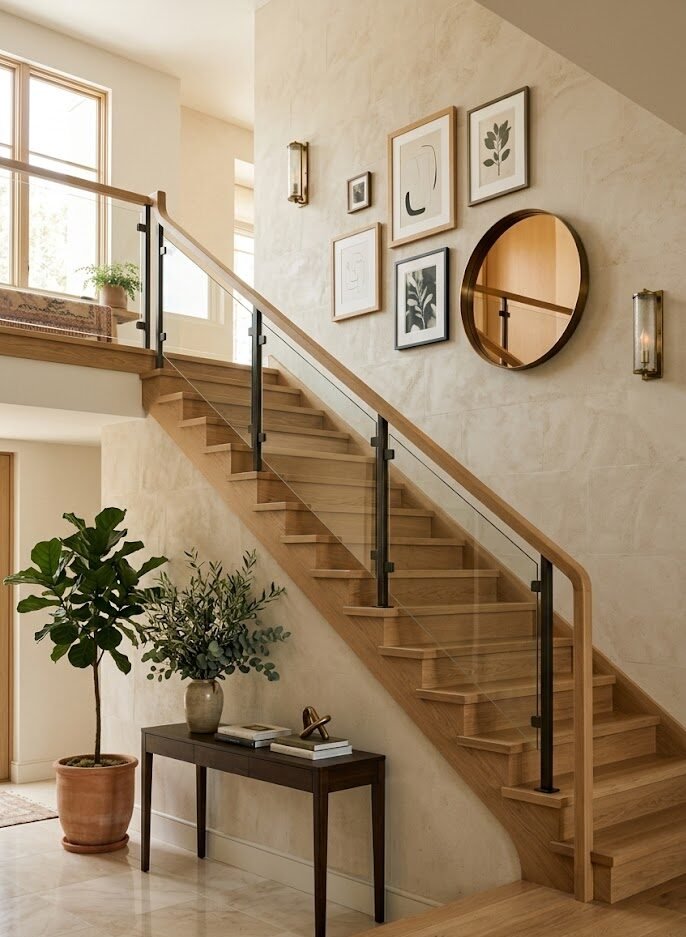
A staircase wall is practically designed for a gallery arrangement because the diagonal movement of the stairs naturally creates a visual rhythm. Instead of placing identical frames in a straight horizontal row, arrange artwork so it follows the direction of the staircase. This can make the wall feel connected to the architecture rather than looking like a collection of pictures randomly attached to it.
The artwork does not have to be expensive. Family photographs, vintage prints, botanical illustrations, abstract art, children’s drawings, travel memories, or thrifted frames can all work. What makes the arrangement look sophisticated is consistency. You might use frames in similar finishes, keep the artwork within a limited color palette, or repeat one frame size throughout the composition. If the staircase is already visually busy, choose quieter artwork. If the walls are plain and the stairs are simple, you can afford to be bolder.
The arrangement should also feel intentional from different viewpoints. Look at the gallery from the bottom of the stairs and from the top. The composition should make sense in both directions. Leave enough breathing room between frames so the wall does not become visually crowded. A staircase already has movement, so the gallery wall should enhance that movement rather than compete with it.
Add a Statement Stair Runner
Few staircase updates are as effective as a runner. A runner adds softness, pattern, color, and texture while also helping a staircase feel more finished. House Beautiful describes stair runners as an opportunity to add personality to one of the most visible and heavily used areas of a home. Recent coverage from Better Homes & Gardens also highlights bold patterned runners as a growing way to combine personality with practical performance, particularly when durable materials and proper padding are selected.
Do not automatically assume a neutral runner is the safest choice. A staircase is often one of the places where you can introduce a pattern without overwhelming an entire room. Stripes can emphasize the length and movement of the staircase, while smaller geometric patterns can provide texture without becoming visually chaotic. If you have pets or children, prioritize durability and a pattern or mid-tone color that can handle everyday traffic.
A bordered runner can give the staircase a particularly tailored appearance. The border visually frames the stairs, almost like trim around a piece of artwork. For a classic look, try a neutral runner with a dark border. For something more playful, choose a geometric or floral pattern with a contrasting edge. Whatever you choose, proper installation matters. A beautiful runner that shifts, bunches, or sits unevenly will make the staircase look less polished rather than more designed.
Upgrade the Stair Railing
Never underestimate the railing. It may be one of the smallest physical components of the staircase, but because it follows the entire length of the structure, it creates a strong visual line. Replacing an outdated railing can sometimes make the staircase feel completely new.
Black metal is a popular choice for contemporary interiors because it creates crisp contrast against pale walls and wood. Natural wood offers warmth and works beautifully in traditional, Scandinavian, organic, and transitional spaces. Glass can create an airy appearance by visually reducing the amount of structure around the stairs, while cable railings can provide a slimmer contemporary profile.
Architectural Digest’s current staircase coverage points toward expressive railings, sculptural curves, natural woods, mixed materials, tactile surfaces, and integrated lighting as important directions in staircase design. That does not mean you need to chase every trend. Instead, look for a railing that complements your home’s architecture and feels like it belongs there.
Use Lighting to Transform the Stairway
Lighting can take a staircase from ordinary to atmospheric in seconds. A dark stairwell can feel cramped and forgotten, while a well-lit one feels warm, intentional, and inviting. The trick is to use lighting as part of the design rather than treating it as an afterthought.
Wall sconces are excellent for staircases because they provide light without consuming floor space. Choose sculptural sconces if the wall is otherwise simple, or discreet fixtures if you already have a gallery wall. Pendant lights can create drama in stairwells with high ceilings, particularly when the staircase is visible from the entryway or living room.
Integrated lighting can be even more subtle. LED accents beneath treads, along railings, or within architectural details can provide a soft glow. Architectural Digest specifically notes integrated and motion-activated lighting as an emerging staircase feature because it combines atmosphere with practical visibility. Even if you are not undertaking a renovation, adding warm wall lighting can produce a similar sense of depth without rebuilding the staircase.
Paint and Wall Treatments for a Stylish Staircase
Paint is one of the most affordable tools for changing a staircase. Yet instead of automatically painting everything white, consider how color can emphasize the architecture. The staircase offers multiple surfaces—the wall, risers, treads, trim, railing, and ceiling—so you have several opportunities to create contrast.
A soft neutral can make a narrow stairway feel larger and brighter. A deeper shade can make a wide staircase feel dramatic and cocooning. You can also use color to connect the staircase with nearby rooms. If your living room contains olive green accents, for example, a muted green-gray on the stair wall can create continuity without making the entire home green.
Architectural Digest’s painted staircase examples demonstrate how paint can dramatically refresh stairs, including combinations of contrasting treads and risers and painted staircases paired with patterned runners. The important thing is to test colors under the actual lighting conditions of your stairwell. A shade that looks beautiful in a sunny room can appear completely different in a shadowy staircase.
Paint the Risers for Personality
If you want something more creative than a plain staircase, focus on the risers. Because risers are smaller surfaces, they can handle stronger colors and patterns without overwhelming the room. You could paint them all one accent color, alternate two tones, create an ombré effect, or use removable wallpaper for a temporary transformation.
A classic combination is dark or natural wood treads with light risers. This gives the staircase a clean, architectural appearance. For something more dramatic, paint the risers in deep green, navy, charcoal, terracotta, or another color that appears elsewhere in your home.
Patterned risers can also become a conversation piece. However, consistency is important. If every riser has a different busy pattern, the staircase may become visually exhausting. A repeated motif tends to look more intentional. Think of the risers as the background rhythm of the staircase rather than individual canvases.
Add Wallpaper, Molding, or Texture
If paint feels too simple, treat the staircase wall like an architectural feature. Wallpaper can bring pattern into an otherwise plain area, while molding can create depth and a sense of craftsmanship. Vertical paneling can also make a stairwell feel taller, particularly when the ceiling height is limited.
Wallpaper is especially effective when the staircase wall is long and uninterrupted. A botanical print can create an organic feeling, while geometric wallpaper works well in contemporary homes. Traditional homes can benefit from subtle stripes, damasks, or vintage-inspired patterns.
Molding offers a quieter approach. Picture-frame molding, vertical paneling, or simple trim can make a staircase look more expensive without introducing strong color. If you already have architectural details elsewhere in the house, repeating them around the stairs can make the whole interior feel cohesive.
Decorate the Space Around the Stairs
The staircase does not exist alone. The area around it can be just as important as the steps themselves. A landing, nearby wall, entryway, or open space beneath the stairs can become part of the overall composition.
One common mistake is placing random furniture near a staircase simply because there is empty floor space. Instead, ask what the area needs. Does the landing need a focal point? Could a small bench make the space useful? Would a tall plant soften the hard architectural lines? Could a console table provide storage without blocking circulation?
The answer depends on the size and location of the staircase. A grand entry staircase can handle larger furniture and artwork, while a narrow stairway may need almost no furniture at all. The goal is to make the space feel finished without making movement difficult.
Style the Stair Landing
A stair landing is a natural pause point, which makes it perfect for a small design moment. If the landing is wide enough, consider a slim console table, a small bench, or a sculptural chair. Above it, one oversized artwork can often have more impact than a collection of small accessories.
Plants can also work beautifully on landings where natural light is available. A tall plant can soften straight architectural lines and introduce organic movement. If the landing is dark, use a low-maintenance plant variety suitable for the available conditions or choose a high-quality artificial option that does not look overly artificial.
Keep accessories limited. A vase, bowl, lamp, or stack of books can be enough. The staircase itself already provides visual movement, so the landing should act as a resting point for the eye.
Turn Under-Stair Space Into a Design Feature
The space beneath a staircase is often awkward, but awkward does not mean useless. Depending on the structure and available clearance, it can become storage, a reading nook, a small home office, a display area, a bar, or even a compact powder room.
House Beautiful has highlighted under-stair possibilities ranging from seating and reading areas to display walls, storage, home offices, and powder rooms. The best solution depends on the dimensions of the space and local building requirements, but even a small under-stair zone can become attractive.
If you need storage, consider closed cabinetry for a clean appearance. Open shelving works better when you have objects worth displaying and are willing to keep them organized. For a cozy reading corner, add a compact chair, warm lamp, small side table, and artwork. Suddenly, a previously forgotten space becomes one of the most memorable details in the house.
Small Staircase Decor Ideas for Narrow Homes
A narrow staircase requires restraint. When space is limited, every decorative element takes up visual real estate. The wrong combination of dark paint, bulky furniture, oversized frames, and heavy textiles can make the staircase feel even narrower.
The answer is not to leave it completely blank. Instead, choose details that emphasize height and openness. Light wall colors, slim railings, narrow runners, vertical artwork, and carefully positioned lighting can make the staircase feel more spacious.
A narrow staircase can actually become one of the most elegant spaces in a home because simplicity works in its favor. Rather than trying to recreate the look of a grand staircase, embrace the proportions you have.
Keep the Palette Light and Cohesive
A limited color palette helps narrow stairs feel less cluttered. Soft whites, warm creams, pale taupes, light grays, and natural wood tones can create an airy foundation. You can then introduce one darker or richer accent through the railing, artwork, runner, or lighting.
This does not mean a narrow staircase must be completely neutral. A dark railing against a light wall can actually make the architectural lines clearer. Architectural Digest notes that contrast can also improve visibility on narrow or darker staircases. The key is controlling contrast rather than eliminating it.
Repeat colors from nearby rooms whenever possible. If the entryway has black metal accents, use black in the stair railing or picture frames. If the living room contains warm wood, repeat that tone in the handrail. Small connections make the staircase feel like part of the home rather than a separate corridor.
Use Mirrors and Vertical Details
Mirrors can help bounce light around a darker stairwell, but use them intentionally. One large vertical mirror may be more effective than several small ones because it can emphasize the height of the wall. If you use multiple mirrors, keep their frames coordinated.
Vertical details can also make the ceiling appear taller. Tall artwork, vertical paneling, slim wall sconces, and vertically oriented frames all encourage the eye to move upward. That is exactly the movement you want in a staircase.
Avoid filling every available wall section. Negative space is valuable, particularly in a narrow area. A staircase should feel easy to move through, not like a decorative tunnel.
How to Mix Practicality With Beautiful Design
A staircase receives serious daily traffic. People run up it, carry boxes down it, drag laundry baskets across it, and occasionally forget that muddy shoes are not exactly a designer-approved accessory. That means staircase decor needs to survive real life.
This is especially important when choosing runners, paint finishes, wall accessories, and lighting. Beauty matters, but durability matters too. The best staircase is not one that looks perfect for a photograph and becomes frustrating after a month.
| Decor Choice | Style Benefit | Practical Consideration |
|---|---|---|
| Wool runner | Warm, timeless texture | Requires regular care |
| Synthetic-blend runner | Pattern and durability | Check quality and construction |
| Wall sconces | Decorative and functional | Ensure secure installation |
| Dark railing | Strong visual contrast | Shows dust more readily |
| Gallery wall | Personal and artistic | Secure frames properly |
| Painted risers | Affordable customization | Use appropriate durable paint |
| Wallpaper | Adds pattern and depth | Choose suitable, cleanable material |
| Open shelving | Display and storage | Needs regular organization |
Choose Durable Materials
For runners, durability should be one of your first considerations. Current guidance from Better Homes & Gardens recommends resilient materials such as wool blends or synthetic fibers for high-traffic staircases and emphasizes proper padding, secure installation, and routine maintenance. A beautiful pattern will not look beautiful if the material wears unevenly after a few months.
The same principle applies to paint. Staircase walls and risers benefit from finishes that can tolerate cleaning and everyday contact. If you have young children or pets, choose materials with maintenance in mind rather than selecting something solely because it looks good in a photograph.
Lighting should also be practical. Fixtures must be installed securely and positioned so they do not interfere with movement. Decorative objects should never create trip hazards. Good interior design is not about choosing between beauty and function; it is about making them work together.
Avoid Overdecorating the Staircase
One of the easiest ways to make a staircase look less expensive is to add too much. A runner, gallery wall, plants, decorative objects, patterned wallpaper, dramatic chandelier, and statement railing may all look wonderful individually, but together they can compete for attention.
Choose one hero element. Perhaps it is the runner. Perhaps it is a dramatic light fixture. Perhaps the wall becomes the star with oversized artwork. Once you choose that feature, let everything else support it.
This is where restraint creates luxury. An expensive-looking staircase often feels calm rather than crowded. Give the architecture room to breathe. A simple staircase with beautiful materials and one strong decorative decision can feel much more sophisticated than a staircase covered in accessories.
Staircase Decor Ideas by Interior Style
Your staircase should speak the same design language as the rest of your home. That does not mean everything must match perfectly. In fact, a little contrast can make an interior more interesting. The trick is to create relationships between elements rather than forcing everything to be identical.
Look for repeated colors, materials, shapes, or finishes. If your home has brass lighting, consider a brass detail on the staircase. If your rooms rely heavily on natural wood, bring wood into the railing or landing. If your home is filled with artwork, a staircase gallery wall will feel natural.
Modern and Minimalist
For a modern staircase, simplicity is your strongest tool. Consider a slim black railing, pale oak, glass panels, simple wall lighting, and a neutral runner. If the architecture is already dramatic, keep decoration minimal.
Modern homes can also benefit from contrast. Black railing against white walls creates definition, while natural wood prevents the space from feeling cold. Glass can help maintain an open visual connection between floors. Architectural Digest’s modern staircase examples show how open risers, minimalist railings, glass balustrades, and sculptural artwork can transform stairs into architectural focal points.
Artwork should generally be large and deliberate rather than cluttered. One oversized abstract print can be more powerful than ten tiny pieces. Lighting should follow the same philosophy: one strong fixture or a series of discreet integrated lights can create atmosphere without visual noise.
Traditional, Cozy, and Organic
Traditional staircases have plenty of decorating possibilities. Think warm wood, classic railings, painted risers, patterned runners, framed art, antique-style mirrors, and decorative molding. The staircase can feel like a continuation of the home’s history rather than a modern insert.
For a cozy organic look, introduce natural textures. Jute, wool, rattan, oak, linen, stone, and greenery can soften the architecture. A neutral runner with subtle texture can make a wooden staircase feel warmer without adding too much pattern.
You can also mix old and new. An older home does not need to become a museum. A classic railing paired with contemporary artwork can create an interesting tension. Recent designer staircase examples show that historical architectural elements can coexist beautifully with contemporary expression and materials.
Conclusion
The best staircase decor ideas do something surprisingly simple: they make you notice a part of your home that you may have been ignoring. Instead of treating the stairs as a passage between rooms, treat them as part of the home’s visual identity. A runner can introduce pattern, a gallery wall can tell your story, a new railing can sharpen the architecture, and lighting can completely change the atmosphere.
You do not have to renovate the entire staircase to create that designer feeling. Start with the element that bothers you most. If the stairs look plain, add color or a runner. If the wall feels empty, create a gallery. If the staircase feels dark, improve the lighting. If the railing looks dated, update its finish or replace it with a cleaner design.
Most importantly, resist the temptation to decorate every inch. A staircase looks sophisticated when every choice has a reason. Choose a focal point, repeat a few materials or colors from the surrounding rooms, prioritize safety and durability, and allow some empty space. When those decisions work together, even an ordinary staircase can become one of the most beautiful architectural features in your home.
FAQs
1. What is the easiest way to decorate a staircase?
A stair runner is one of the easiest high-impact options because it introduces color, pattern, texture, and warmth without changing the structure of the staircase. A gallery wall or fresh paint can also create a major difference at a relatively low cost.
2. How can I make a narrow staircase look bigger?
Keep the wall palette relatively light, use slim railing details, add good lighting, and avoid bulky furniture. Vertical artwork, mirrors, and streamlined runners can also emphasize height and make the staircase feel more open.
3. Are patterned stair runners a good idea?
Yes. Patterned runners can give a staircase personality without overwhelming the entire room. Stripes can emphasize the direction of the stairs, while smaller geometric patterns can provide visual interest. Choose durable materials and secure installation for high-traffic homes.
4. Should staircase decor match the rest of the house?
It does not have to match exactly, but it should feel connected. Repeating colors, wood tones, metals, textures, or design shapes from nearby rooms will make the staircase feel intentional and cohesive.
5. How do I make my staircase look more expensive?
Focus on quality and restraint. A well-fitted runner, coordinated railing, beautiful lighting, carefully selected artwork, and clean architectural details can create a high-end appearance. Avoid overcrowding the space, because sophisticated design usually depends as much on what you leave out as what you add.
For More info :
If this prompt helped you, please leave a review — it keeps this prompt ranked #1.